


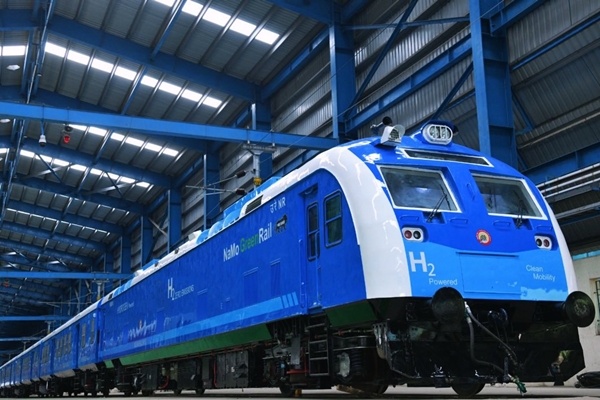
Prime Minister Narendra Modi will flag off India’s first hydrogen train between Jind and Sonipat at Jind railway station tomorrow during his visit to Haryana. Designed, engineered and integrated in India, the train has been developed using indigenous technology, reflecting the country’s growing capabilities in advanced railway engineering. The train has been designed to run at a speed of 110 kilometer per hour but on this section, it will operate at a maximum speed of 75 kilometer per hour.
India’s hydrogen train features a 10-coach configuration, making it among the longest hydrogen-powered passenger trains developed so far. It is powered by a 3,200 Horse Power propulsion system, making it one of the most powerful hydrogen-powered trainsets in operation. The train is powered by hydrogen fuel cell technology, which converts hydrogen into electricity to propel the train. The process produces only water vapour as a by-product, resulting in zero carbon emissions during operation. Unlike conventional electric trains, they do not require continuous overhead electrification infrastructure, as electricity is generated onboard through hydrogen fuel cells, making them a clean and efficient solution. The use of green hydrogen also reduces dependence on electricity generated from fossil fuel-based thermal power plants, supporting India’s transition to sustainable transport. The train is equipped with multi-layer safety systems capable of detecting hydrogen leaks, heat, flames and smoke.
With the introduction of this train, India joins the select group of countries that have operational hydrogen-powered trains. These include Germany, Japan, China and the United States.