

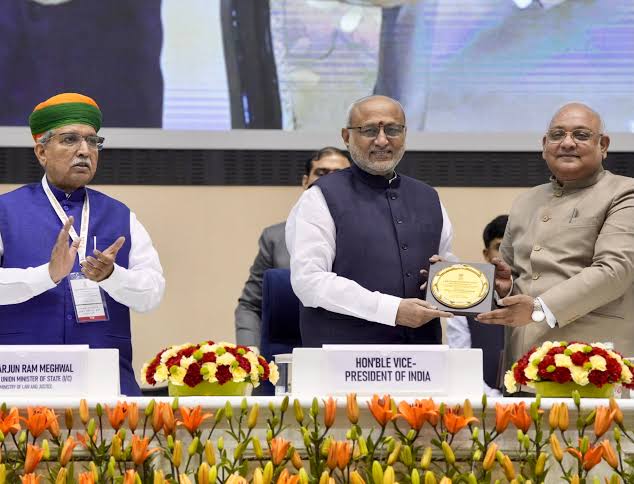
Vice President C P Radhakrishnan today said that the replacement of three colonial-era criminal laws with the Bharatiya Nyaya Sanhita, Bharatiya Nagarik Suraksha Sanhita and Bharatiya Sakshya Adhiniyam marks a major step towards legal reforms in the country.
Mr Radhakrishnan said this while inaugurating the National Conference on Cooperative Federalism and Legal Reforms: National and State Perspectives, in New Delhi. He noted that the government had repealed more than 1,700 obsolete and redundant laws over the last twelve years to simplify and modernise the legal framework. He added that consultations, sharing of best practices and reviews of outdated laws could help make legislation more responsive to local needs while advancing common national objectives.
Emphasising the spirit of ‘Team India’, the Vice President called for greater consultation, coordination and shared responsibility between the Centre and States, noting that political differences must never come in the way of the larger public interest.
Highlighting the importance of cooperative federalism, the Vice-President said the Constitution balances the strength of the Union with the constitutional responsibilities and legitimate autonomy of states. He stressed that political differences should not prevent governments from working together in the larger interest of the nation. Mr Radhakrishnan also expressed hope that the conference would produce concrete and actionable recommendations.
The Vice President emphasised that achieving the vision of Viksit Bharat@2047 requires comprehensive legal reforms, supported by sound laws, transparent institutions, efficient administration and access to justice for all. Referring to the Sengol installed in Parliament as a symbol of righteous authority and ethical governance, Mr Radhakrishnan invoked the timeless wisdom of Tamil saint-poet Thiruvalluvar on good governance and adherence to the rule of law. He emphasised that good governance, rather than the exercise of power alone, is the foundation of lasting success and prosperity.
Addressing the event, Law and Justice Minister Arjun Ram Meghwal has said that in the 21st century, India is recognised not merely as the world’s largest democracy, but also as the Mother of Democracy. He said that India’s ancient republics and rich traditions of collective deliberation have strengthened public participation.
Mr Meghwal emphasised that this legacy highlights the importance of continued dialogue despite differences of opinion, with public welfare remaining at the centre of decision-making. The Minister said that despite the diversity of languages, cultures and regional aspirations, the shared commitment to the rule of law and justice binds the nation together.
Mr Meghwal also stated that States are not merely implementing agencies for government schemes but active partners in shaping the country’s development priorities.