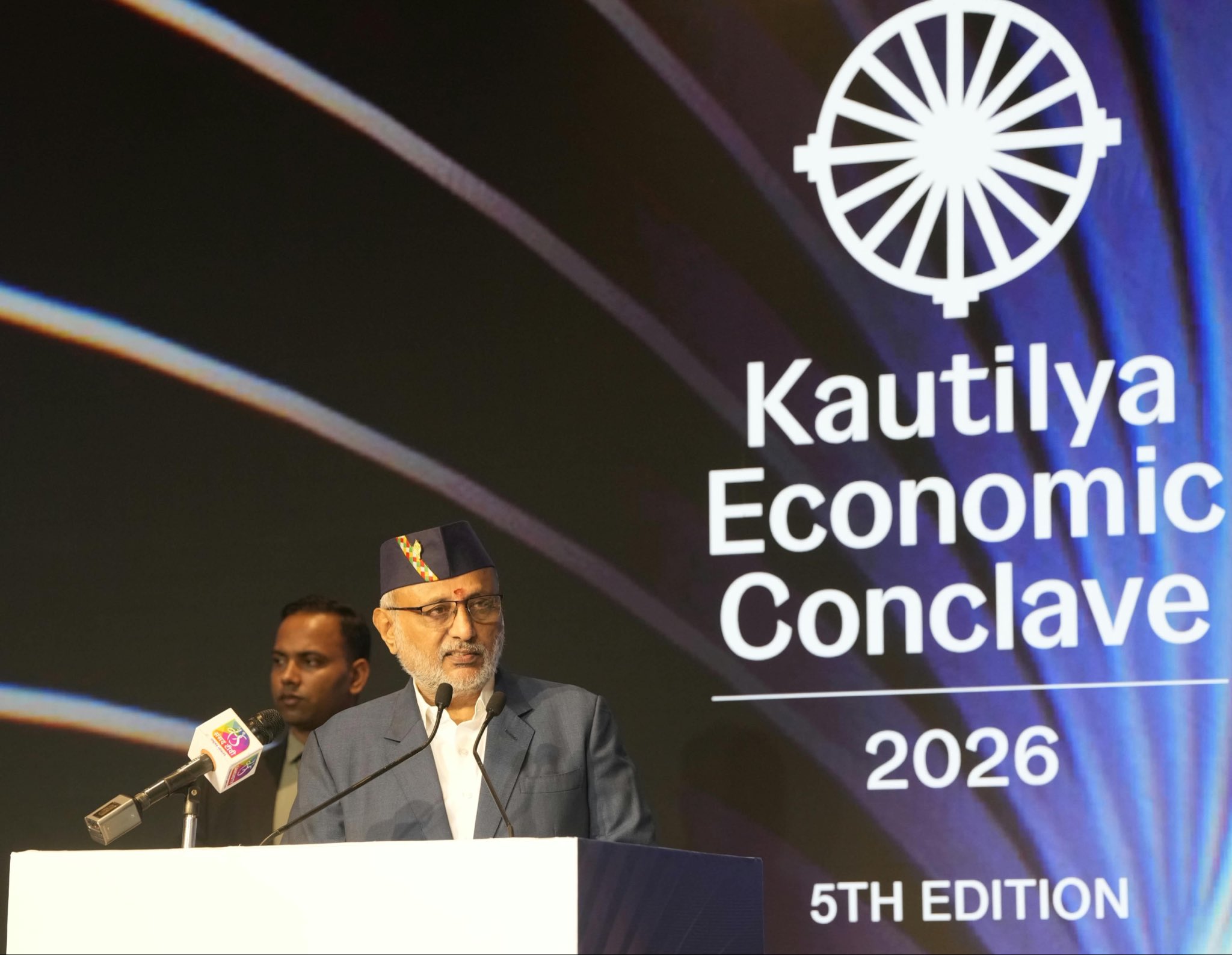
Vice President C.P. Radhakrishnan emphasised that economic resilience cannot be separated from social resilience and that inclusion is the foundation of resilience in a rapidly changing world. Mr Radhakrishnan made these remarks during the inaugural address at the 5th Kautilya Economic Conclave in New Delhi today. The theme of the conclave was ‘Resilience in an Age of Flux’.
The Vice-President said democracy and development can advance together, with consensus, inclusion and responsive policymaking providing the foundation for sustainable growth. He stressed that true resilience lies in ensuring that no citizen, enterprise or region is left behind and called for collective efforts towards building a Viksit Bharat by 2047.
Mr Radhakrishnan emphasised the need for decisiveness through consensus in the wake of rapidly changing global priorities, advancing technology and intensifying climate challenges. The Vice President said that in times of crisis, there is a greater need for decisions based on consensus. He noted that while debate and discussion are essential, they must ultimately lead to a final conclusion that is acceptable to all.
Addressing a session on the theme of ‘A World Price for Risk’, Principal Secretary to the Prime Minister Dr P K Mishra observed that geography has become an important economic variable in today’s world. He noted that a disruption along a major shipping route can affect crude oil prices thousands of kilometres away. Dr Mishra noted a supply chain that is efficient under normal circumstances can become vulnerable when a single-node supplier or a particular geography becomes unavailable. He added that the challenge, therefore is not simply to optimise for efficiency, but also to account for resilience and the risks associated with disruption.
Reserve Bank of India (RBI) Governor Sanjay Malhotra said that price and financial stability cannot be seen in isolation from geopolitical and geo-economic fragmentation, trade restrictions, supply shocks and technological disruption. The RBI Governor said that the world has resiliently weathered repeated shocks, including during the Covid-19 pandemic.
Mr Malhotra stressed that the full potential of economic growth cannot be achieved without a stable and healthy financial system. He said that the Indian financial system is very resilient, supported by healthy balance sheets and NBFCs. The RBI Governor said that Central banks work to act as a shock absorber, focusing on enhancing the resilience of the financial system.
Mr Malhotra said that regulations aim to build a financial system that is well capitalised, liquid and well governed, so that it can manage and absorb shocks. He added that these are aimed at striking a balance between risk management and supporting economic growth. The RBI Governor also focused on the use of modern tools, data analytics, technology-enabled surveillance and thematic assessments to identify risks at an early stage.
He said that India has recorded the strongest growth among major economies even during the West Asia conflict. He added that further measures are being taken to build resilience. He also highlighted the need to remain alert to banking and financial stresses and said that the economic and financial cost of allowing vulnerabilities is too high.