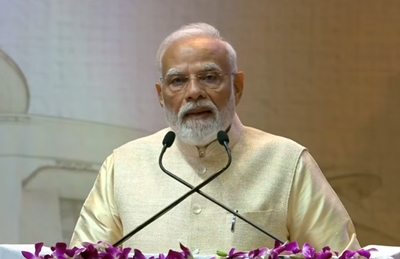



Chief Justice of India Surya Kant today said that technology must be harnessed to make justice more accessible, transparent and responsive, while ensuring that constitutional values and the human character of adjudication remain protected.
Addressing the opening session and plenary of the Seventh Congress of the Association of Asian Constitutional Courts and Equivalent Institutions in Samarkand, Uzbekistan, the CJI said the Congress provides an important platform for Asian constitutional courts to exchange experiences and develop principles suited to a common technological future. He said digitalisation can improve access to courts, reduce delays and simplify procedures, while Artificial Intelligence can assist judges and court staff in research and handling large volumes of information.
The CJI emphasised that constitutional courts must remain anchored to the principles of dignity, equality, liberty and fairness. He said the challenge is not to choose between tradition and technology, but to bring the best of technology into judicial institutions while keeping the Constitution as the guiding framework.
Speaking on the theme of digitising justice, the CJI said the Supreme Court of India’s approach is based on three constitutional promises-liberty under Article 21, equality before law under Article 14, and access to justice through Article 32 and free legal aid under Article 39A. He said digitisation is being treated not merely as computerisation, but as an opportunity to re-engineer judicial processes around citizens.
He highlighted the eCourts Mission Mode Project, launched in 2011, under which electronic filing, virtual hearings, digital case management and live-streaming have expanded access to justice. During the COVID-19 pandemic, the Supreme Court alone conducted more than seven lakh fifty thousand hearings through video conference between March 2020 and June 2024.
The CJI outlined four major initiatives of the Indian Judiciary. These include SUVAS, an AI-assisted translation tool through which more than 83 thousand judgments had been translated into 18 Indian languages; Su-Sahayak, an AI-powered chatbot providing case status, cause lists, orders, judgments and e-services guidance; and One Case, One Data, which integrates case information across different levels of the judiciary to reduce duplication and delay.
He also referred to the Supreme Court AI Committee’s Draft Regulations for Use of Artificial Intelligence in Courts, released in June this year. He stressed that the regulations are based on the principle of human primacy, with AI supporting judicial research and court processes but never replacing judicial acumen or decision-making, which must remain with judges.
The CJI cautioned that the digital divide, data security and algorithmic accountability remain common challenges for Asian constitutional courts. He said the AACC can facilitate shared learning and help courts strengthen their technological networks, while ensuring that justice remains accessible, accountable and, above all, human.