


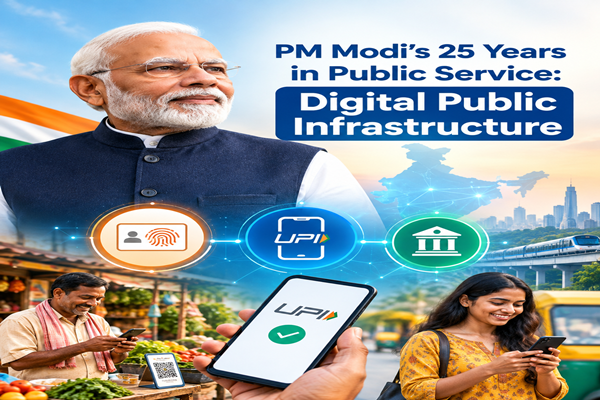
Prime Minister Narendra Modi is completing 25 years in public service, a journey defined by the mantra of Jan Seva Se Desh Seva, and a relentless commitment that continues. Guided by this vision for Seva and Sushasan, the Government has been ceaselessly working towards achieving the goal of a Viksit Bharat by 2047. Through inclusive development and social empowerment, this dedication is transforming lives. Today, in our special series, we bring you an instance of how this vision has been translated into action through the Digital Public Infrastructure.
Digital Public Infrastructure is reshaping how nations govern, transact and deliver services. In this transformation, India has moved from being a large user of digital systems to a builder of population scale digital architecture. India has built three layers of shared digital infrastructure and left each of them open for others to build on. First is Aadhaar which provides a verifiable identity. UPI moves money between any two bank accounts instantly, at no charge to the person paying. The Account Aggregator framework lets a citizen share their own financial record with a lender or insurer, with consent. Addressing the Global Fintech Fest 2026 this month in Mumbai, Prime Minister Narendra Modi highlighted UPI’s remarkable 10-year journey and its growing global reach.
Talking to Akashvani News, Sharanyam Singh, a resident of Patna said he used to check if he had enough cash in his wallet before stepping out but now, he easily pays for tea, auto rides, groceries, or meals in seconds using UPI.
Talking to Akashvani News, Divya Pratap Singh a resident of Fatehpur said that one had to travel hundreds of kilometers just to conduct a transaction. He added that money is now largely managed on phones through UPI which offers a distinct advantage, including from a legal standpoint.
India’s journey with Digital Public Infrastructure reflects a broader shift in how development and governance are conceived in the digital age. What began as an effort to expand financial inclusion and identity access has matured into a comprehensive, interoperable architecture that underpins economic activity, public service delivery and institutional capacity.