

The Lok Sabha today resumed discussion on the Constitution (One Hundred and Thirty-First Amendment) Bill, 2026, the Delimitation Bill, 2026, and the Union Territories Laws (Amendment) Bill, 2026. The three bills are intended to increase the participation of women in the Lok Sabha and the assemblies of States and Union Territories.
Taking part in the discussion, Leader of Opposition in the Lok Sabha and Congress MP, Rahul Gandhi said that Nari Shakti Vandan Adhiniyam is not a women’s reservation bill and it has nothing to do with the empowerment of women. He claimed that this is an attempt to change the electoral map by bringing these bills into the Parliament.
Mr Gandhi alleged that it will deprive Dalits and OBCs of their rightful place in society. He also alleged that the women’s reservation bill is aimed at sidelining the caste census, asserting that it overlooks the discrimination faced by OBCs, Dalits, minorities, and women.
Lok Sabha Speaker Om Birla objected to the Leader of the Opposition’s remarks, which used a magician analogy while speaking on the bill, and asked him to focus on the legislation.
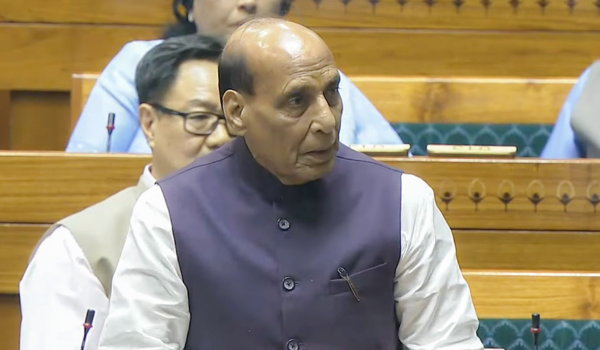
Responding to Mr Gandhi’s speech in the House, Defence Minister Rajnath Singh condemned the Congress MP’s attack on Prime Minister Narendra Modi, demanded an apology, and called for the expunging of such remarks from his speech. Parliamentary Affairs Minister Kiren Rijiju also condemned Rahul Gandhi, termed his remarks un-parliamentary, and asked him to speak on the Bill in accordance with the rules of procedure.
Participating in the discussion, Union Minister HD Kumaraswamy said that women’s reservation should not be viewed as a favour but as a rightful recognition for their contribution to society. Mr Kumaraswamy said after nearly 75 years of independence, the government has taken a historic step by ensuring fair and meaningful reservation for women in the Lok Sabha and State Legislative Assemblies.
He reiterated that under the leadership of Prime Minister Narendra Modi, India is undergoing a deep and meaningful transformation. The Minister said today, India is being viewed with admiration across the world, particularly at a time when many nations are facing conflict and instability. He further added that India continues to move forward with confidence, guided by reform, stability, and a clear vision.
He said a particularly significant aspect of this progress is the growing recognition of women’s power in the world’s largest democracy. Mr Kumaraswamy said, alongside the vision of Atmanirbhar Bharat, the nation is steadily advancing towards building a strong Bharat with women’s empowerment.
Speaking on the Bills, Sandhya Ray of BJP said that the Nari Shakti Vandan Adhiniyam is not merely a piece of legislation, but a symbol of dignity, rights, and empowered participation of half of India’s population. She extended her gratitude to Prime Minister Modi for this historic initiative, under whose visionary leadership this dream is becoming a reality.
Ms Ray said, in Indian culture, women have always been regarded as a symbol of strength. She added that the Modi government has placed women’s empowerment at the centre of governance. Ms Ray said, this government considers women not merely as beneficiaries, but as a leading force in nation-building. She also highlighted that today, many women across the country are bringing about positive change in society through their hard work and dedication and are making significant contributions to the nation’s development.
Supporting the three bills introduced by the government in the Lower House, Union Women and Child Development Minister Annapurna Devi said, under the leadership of Prime Minister Narendra Modi, women are not just participants in the development journey of the country but also the key decision makers in shaping the nation’s future. The Minister condemned the unparliamentary words used by the Leader of the Opposition, Rahul Gandhi, during his speech.
She alleged that the Opposition MPs’ attempts are breaking the hopes and expectations of crores of women who are looking forward to the 33 per cent reservation. The Minister described the legislation as a historic milestone reflecting India’s commitment to inclusive governance and women-led development. She added that the legislation fulfils decades-long aspirations of millions of women across the country.
Taking part in the discussion, BJP MP Hema Malini said the Women’s Reservation Bill is not just a bill but a tribute to the struggle, courage, and strength of all women. She said that for centuries, women have empowered their families and communities without any sense of identity. She said, the bills provide them not just representation but an opportunity to raise their voices.
Participating in the debate, DMK MP K Kanimozhi opposed the bills, saying it is shocking that the Centre notified the women’s reservation law, passed in 2023, last night. She questioned the need for this move when a discussion is taking place on Women’s Reservation in Parliament. Ms Kanimozhi alleged that the government has introduced the three bills in this special sitting in order to disrupt the ongoing elections in Tamil Nadu and other states.
She claimed that these bills are disguised as if they are in support of women’s reservation, but are actually against the Indian federal structure. She asked why the Delimitation Bill is not being placed in the Tamil Nadu legislature if the government is confident that the Delimitation Bill is fair.
Congress MP Shashi Tharoor said today, the nation stands at the threshold where there is near-unanimous political consensus in favour of women’s reservation. He expressed concern that the implementation of women’s reservation has been tethered to the expansion of Parliament and to numbers from the 2011 Census and an exercise of delimitation. He said that to link this to delimitation is to hold the aspirations of Indian women hostage to one of the most complex administrative exercises in India’s history.
Congress leader Shashi Tharoor described the Delimitation Bill as a profound shift in political power and called for extensive discussion before any decision is taken. He said delimitation based on population would further marginalise the voices of those states that provide the lion’s share of resources.
YSRCP MP PV Midhun Reddy said his party has always advocated for the empowerment of women. He said the delimitation process should be a nation-building process and not a tool to crush the Opposition.
Panchayati Raj Minister Rajiv Ranjan Singh said Sabka Saath, Sabka Vikas, Sabka Vishwas, Sabka Prayas has been the vision of Prime Minister Narendra Modi, and the three bills are aimed at fulfilling this vision. He said the Bill provides justice to the women of the country. He accused the Congress party of not wanting to support any work that leads to social revolution.
TMC MP Kalyan Bannerjee questioned the need for a special sitting of Parliament during assembly polls, terming this as unfair and unfortunate. He said the party supports women’s reservation but demanded that it has to be implemented on the present capacity of Parliament. He said there is no need the link delimitation with women’s reservation.
TDP MP Lavu Sri Krishna Devarayalu spoke in support of the bills, saying that Home Minister Amit Shah has already clarified yesterday on 50 per cent increase of seats for States in the Lok Sabha.
Dimple Yadav of the Samajwadi Party said if the Centre wants to provide justice to women, they should work towards the education of girl children. She asked why many schools have closed in Uttar Pradesh.
Harsimrat Kaur Badal of SAD demanded that women’s reservation must be implemented on the present capacity of Parliament without delimitation.
Minister of State for Health and Family Welfare, Anupriya Patel, said this is a historic occasion to increase the participation of women in nation-building. The discussion is underway.