

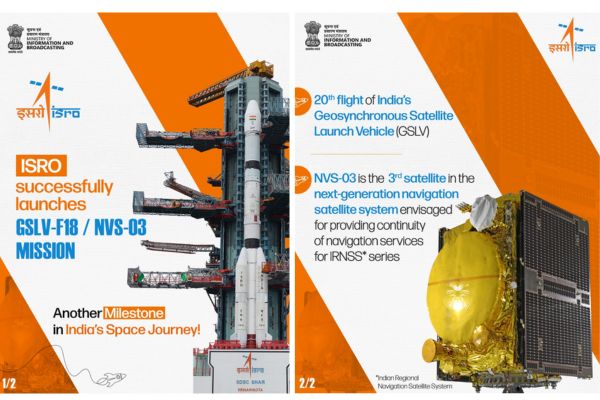
The Indian Space Research Organisation (ISRO) has successfully launched its next-generation navigation satellite, NVS-03, marking a significant step towards strengthening the country’s indigenous satellite navigation capabilities.
The Geosynchronous Satellite Launch Vehicle (GSLV-F18), carrying the satellite, lifted off from the Second Launch Pad at the Satish Dhawan Space Centre in Sriharikota, Andhra Pradesh, last night. It was the 20th flight of the GSLV. The satellite was successfully separated from the launch vehicle and placed in its intended Geosynchronous Transfer Orbit.
NVS-03 is the third satellite in ISRO’s second-generation navigation satellite series. It is designed to ensure continuity and improve the availability of navigation services under the Navigation with Indian Constellation (NavIC), the country’s indigenous alternative to the Global Positioning System (GPS).
The satellite carries an indigenous atomic clock along with procured atomic clocks. It also introduces the L1 frequency band in addition to the existing L5 and S bands, enhancing the capabilities of India’s regional navigation system.
The mission is particularly significant for India as it seeks to strengthen its independent positioning, navigation and timing capabilities, which are crucial for civilian, strategic and security applications.
ISRO Chairman Dr V. Narayanan congratulated the scientists, engineers, industrial partners and academic institutions associated with the mission. Addressing the gathering after the launch, Dr Narayanan said that the satellite, weighing approximately 2,232 kilograms, had been precisely injected into its intended transfer orbit. He also highlighted that the mission was accomplished with a turnaround time of just 56 days between two successive GSLV missions, the shortest interval achieved so far.
Speaking to the media later, Dr Narayanan said that ISRO had placed its third indigenous atomic clock in orbit aboard the NVS-03 navigation satellite. He said that two indigenous atomic clocks were already functioning in orbit. He added that the satellite was launched as part of India’s Regional Navigation Satellite System, which aims to provide navigation services across the country and up to 1,500 kilometres beyond its borders.
Explaining the objectives of the programme, Dr Narayanan said that it envisages a constellation of seven satellites in orbit to provide these services. He added that NVS-03 was the fourth satellite launched under the programme. He said that with four satellites in orbit, the signals could be used for multiple purposes. The ISRO Chairman added that the constellation would need to be completed before navigation services could be integrated with mobile systems for wider public use.