

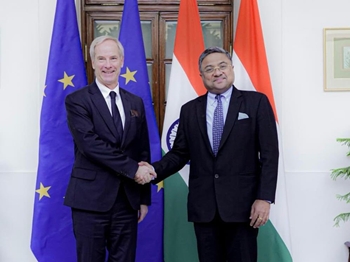
India and the European Union unequivocally and strongly condemned terrorism and violent extremism, in all its forms and manifestations, including cross-border terrorism. Secretary (West) in the Ministry of External Affairs, Sibi George and Deputy Secretary General for Political Affairs of the European External Action Service, Olof Skoog, co-chaired the 12th India-EU Foreign Policy and Security Consultations (FPSC) in New Delhi.
They reviewed the strong momentum and current state of play in India-EU relations. The two sides also discussed ways to further deepen the strategic partnership, in line with the Towards 2030: A Joint India-European Union Comprehensive Strategic Agenda endorsed at the 16th India-EU Summit held in January this year.
During the meeting, India and EU underlined their firm commitment to upholding the UN Charter and the rules and principles it enshrines, in particular those of sovereignty and territorial integrity.
They also emphasised the importance of an effective multilateral system, with the United Nations at its core and exchanged views on important regional and global developments, including in the Indo-Pacific.
Ministry of External Affairs said that the consultations reaffirmed India and the EU’s shared commitment to deepening their strategic partnership, strengthening cooperation in addressing common security challenges and promoting regional stability.
Both sides emphasised the importance of closer coordination in support of a free, open, peaceful and prosperous Indo-Pacific built on international law and mutual respect for sovereignty, territorial integrity and peaceful resolution of disputes.
India and EU also exchanged perspectives on security and defence cooperation under the India-EU Security and Defence Partnership, including maritime security, defence industry and technology, cyber and hybrid threats, space and counterterrorism.
They also reaffirmed their commitment to deepen the India-EU Strategic Partnership, including through regular high-level exchanges and existing institutional dialogue mechanisms, and to deliver mutually beneficial, concrete and transformative outcomes.