

The Union Cabinet has approved two elevated highway projects worth over 25,000 crore rupees for Varanasi in Uttar Pradesh. The Cabinet Committee on Economic Affairs (CCEA), chaired by Prime Minister Narendra Modi, approved the projects to improve road connectivity and reduce congestion and travel time in Varanasi.
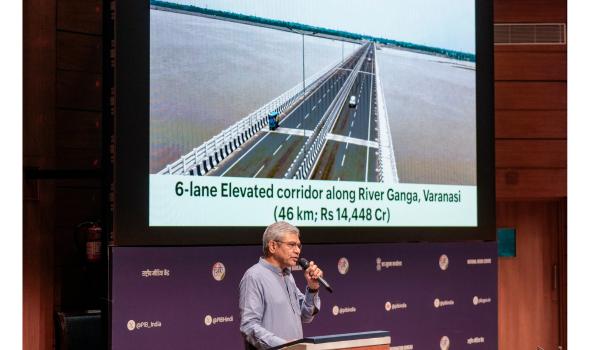
The projects include a six-lane Greenfield Elevated Corridor spanning over 46 kilometres between National Highway-19 and the Varanasi Ring Road in Uttar Pradesh under the Hybrid Annuity Model. The project will be built at a total capital cost of over 14,400 crore rupees.
Briefing the media in New Delhi, Information and Broadcasting Minister Ashwini Vaishnaw said the other project involves the development of an around 43-kilometre-long six-lane and four-lane Elevated Corridor along the Varuna River bank in Varanasi at a cost of around 11,000 crore rupees.
The Union Cabinet also approved Semicon 2.0 with a budgetary outlay of 1,27,500 crore rupees to strengthen India’s semiconductor design and manufacturing ecosystem. Mr Vaishnaw said that, building on the momentum of Semicon 1.0, the scheme aims to further the government’s commitment to placing India on the global semiconductor map. He said investments worth around four lakh crore rupees are expected under Semicon 2.0.
The Minister said the Cabinet also approved the Mobile Phone Manufacturing Scheme with a budgetary outlay of 62,500 crore rupees. He said the scheme aims to scale up domestic mobile phone production, deepen local value addition and strengthen India’s position as a global electronics manufacturing hub.
The Cabinet also approved two multitracking railway projects covering four districts in Odisha and Jharkhand, expanding the Indian Railways network by about 145 kilometres. It also approved the National Investment Policy for Urea-2026 under the vision of Atmanirbhar Bharat. The policy seeks to encourage new investments in the urea sector for setting up gas-based urea manufacturing units in the country, helping achieve the goal of self-sufficiency.