

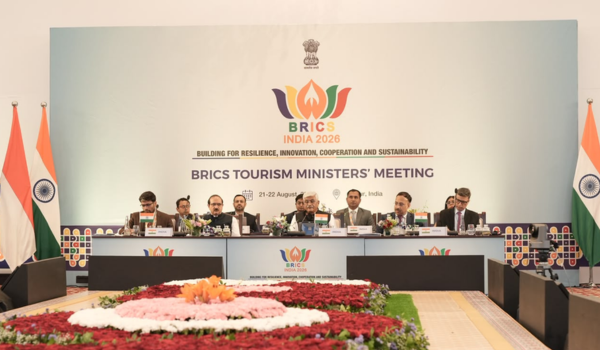
The BRICS Tourism Ministers’ Meeting, held under India’s Chairship, concluded yesterday with the unanimous adoption of the Jaipur Declaration, which provides a framework for strengthening tourism cooperation among BRICS member countries. The declaration outlines key areas of cooperation, including the use of artificial intelligence in tourism, sustainable tourism practices, skill development and seamless travel facilitation.
The meeting was presided over by Union Minister for Culture and Tourism Gajendra Singh Shekhawat in Jaipur, Rajasthan, and marked the culmination of the BRICS Tourism Track under India’s Chairship in 2026. The Tourism Track was taken forward under the theme, “Building for Resilience, Innovation, Cooperation and Sustainability.”
Addressing the meeting, Mr Shekhawat said tourism will play an important role in India’s journey towards Viksit Bharat by 2047 and has the potential to extend economic growth beyond major urban centres to towns, villages and remote regions. He said the sector creates opportunities for hotels and homestays, taxi operators, tourist guides, artisans, weavers, farmers, entrepreneurs and millions of families whose livelihoods are directly or indirectly linked to tourism. He highlighted India’s efforts to build a tourism ecosystem that is economically prosperous, environmentally responsible, technologically enabled and culturally authentic.
The BRICS Tourism Ministers’ Communiqué 2026, also known as the Jaipur Declaration, reflects the work undertaken by the BRICS Tourism Working Group during India’s Chairship and focuses on four key priorities: Artificial Intelligence and Tourism; Sustainability and Responsible Tourism; Tourism Skilling and Capacity Building; and Tourism Exchanges and Seamless Travel Facilitation. The Ministers’ Communiqué recognises the potential of responsible, safe and human-centred artificial intelligence and digital technologies to transform the tourism sector. It supports cooperation in areas such as tourism planning, destination management, visitor services, multilingual communication and travel facilitation.
The meeting was attended by representatives of nine BRICS member states. Ministerial participants included Gustavo Costa Feliciano, Minister of Tourism of Brazil; Reza Salehi Amiri, Iran’s Minister of Cultural Heritage, Tourism and Handicrafts; Patricia De Lille, South Africa’s Minister of Tourism; and Abdulla Bin Touq Al Marri, UAE Minister of Economy and Tourism. Heads of delegations from China, Ethiopia, Indonesia and Russia also attended the meeting.
Speaking to the media after the BRICS Tourism Ministers’ Meeting, Union Minister Gajendra Singh Shekhawat said the Jaipur Declaration adopted at the meeting will strengthen joint strategies and cooperation among BRICS countries and open new opportunities in tourism. He called for more effective use of Artificial Intelligence in the tourism sector. He stressed the need to promote responsible tourism and enhance skill development in the sector. Mr Shekhawat said the number of tourists visiting India has tripled over the past decade. He added that Jaipur is also expected to benefit significantly from these initiatives.
On the sidelines of the ministerial meeting, India held bilateral discussions with Brazil, Iran, South Africa and the United Arab Emirates to further advance tourism cooperation.