

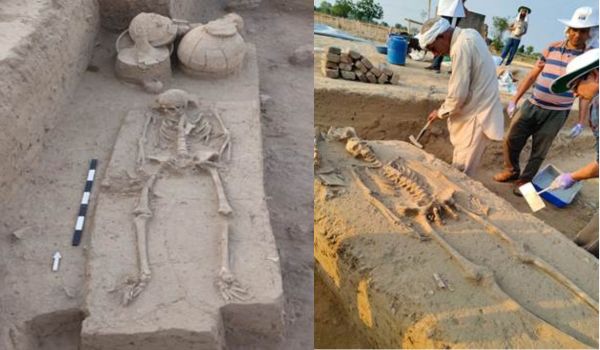
Human skeletal remains excavated from Rakhigarhi in Haryana have been transferred to the Anthropological Survey of India for Advanced Scientific Research.
The transfer is carried out under a recently signed Memorandum of Understanding between the Archaeological Survey of India (ASI) and the Anthropological Survey of India. This move is expected to significantly advance multidisciplinary research into one of the most important urban centres of the Indus-Saraswati Civilisation.
During excavations conducted by ASI in the 2025-26 field season, archaeologists uncovered eight burials at Mound No. 7, an area previously identified as a cemetery. Three complete human skeletons, along with skeletal fragments recovered from other burials, have now been transferred to the Anthropological Survey of India’s ancient human skeletal repository and laboratory in Kolkata for detailed examination. The remaining skeletal materials obtained at these sites are also expected to be transferred in a few days.
Rakhigarhi, spread across approximately 550 hectares in Haryana, is widely recognised as the largest known settlement of the Indus-Saraswati Civilisation.
Archaeological excavations have revealed evidence of continuous habitation from the Early Harappan to the Mature Harappan periods, including planned settlements, drainage systems, craft production centres, trade networks, and burial grounds.