

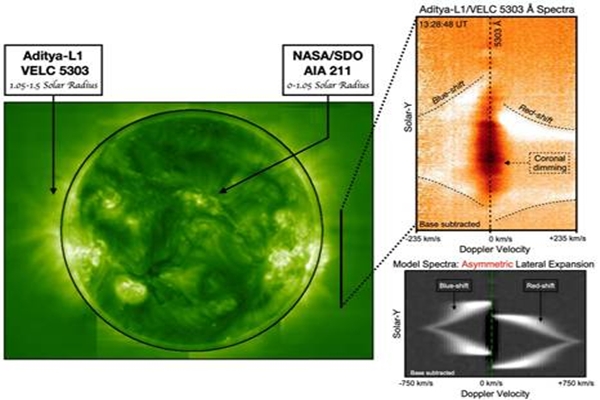
India’s first space-based solar observatory, Aditya-L1, has provided new insights into how powerful solar eruptions expand through space. The Science and Technology Ministry said Aditya-L1 is providing continuous observations of the Sun through its seven scientific payloads. One of these, the Visible Emission Line Coronagraph, or VELC, has helped scientists detect the uneven expansion of solar eruptions, which can influence space weather.
The instrument has enabled researchers to track the movement of hot solar material towards and away from the spacecraft, offering valuable information beyond what can be obtained through images alone. Scientists say variations in the expansion of these eruptions can affect their speed and direction towards Earth, potentially causing space-weather disturbances.
The findings are expected to improve understanding of space weather, which can affect satellites, communication networks and other space-based systems.